Treatment
Obesity treatment in Malaysia: from lifestyle to surgery
Healthy living, weight-loss medicines (including injections), endoscopic procedures and bariatric surgery, explained as four steps.
Written by Dato' Dr Tikfu Gee, MBBS, MS (Surgery), Fellowship in MIS (France)

Obesity is treated in steps, like a staircase. Healthy-living support is the base for everyone. Medicines, endoscopic procedures and surgery are added when more help is needed. People can move up or down the steps over time.
Tap a step to jump to it.
Treatment choices depend on each person’s health. Some treatments can also be combined, as advised by a doctor.
Step 1: Healthy living, with support
What it is: changes to eating, activity, sleep and stress, with help from a doctor, dietitian or programme.
| Benefit shown | Limits |
|---|---|
| In a British trial, a structured diet programme run by family doctors put type 2 diabetes into remission for almost half of participants at one year, and more than a third at two years [8,9] | Remission depended on keeping the weight off. Only about a quarter kept off 10 kg or more at two years [9] |
| Better fitness, blood sugar and heart risk factors in a large American trial [10] | In that trial, weight loss averaged about 9% in the first year and 6% by the end, and heart attacks and strokes were not reduced [10] |
In plain words: healthy living is the foundation and helps everyone. For many people living with obesity, it is not enough alone, because the body pushes the weight back.
Step 2: Medicines
What it is: medicines that help control weight, including certain tablets and injections, used under a doctor’s supervision together with healthy living habits.
| Benefit shown | Limits |
|---|---|
| In a large trial, people lost about 15 in every 100 kg of body weight in 16 months on one of these medicines [11] | Nausea, vomiting and diarrhoea are common early on [11] |
| Blood pressure, blood sugar and physical function improved [11] | When the medicine was stopped, about two-thirds of the lost weight returned within a year [12] |
Step 3: Endoscopic procedures
What it is: procedures done through a camera tube passed down the throat, with no cuts on the tummy. Examples are a temporary balloon in the stomach, or stitches that make the stomach narrower.
| Benefit shown | Limits |
|---|---|
| In a trial, people who had the stomach-narrowing procedure lost about 14 in every 100 kg of body weight in a year [13] | Less weight loss than surgery. Less long-term evidence. A balloon is temporary |
Step 4: Bariatric surgery
What it is: a keyhole operation that makes the stomach smaller and, in some operations, re-routes part of the gut. See What is bariatric surgery?
Which step is for me?
That depends on your BMI, your health conditions, what you have tried, and what you prefer. A higher step is not “better”. It is more treatment, for when more is needed. A qualified doctor can go through the options with you.
Want more detail? Tap to open
- DiRECT trial (United Kingdom): remission of type 2 diabetes in 46% at one year and in more than a third at two years with a diet programme, in people who had had diabetes for less than six years and were not on insulin. Of those who kept off at least 10 kg, 64% were in remission [8,9].
- Look AHEAD trial (United States): weight loss 8.6% at one year and 6.0% at the end of the study with intensive lifestyle support; no reduction in heart attacks and strokes (hazard ratio 0.95) [10].
- Semaglutide 2.4 mg: average weight change −14.9% at 68 weeks, against −2.4% with a dummy injection [11]; two-thirds of the loss was regained within a year of stopping [12]. Both studies were funded by the maker.
- Endoscopic sleeve gastroplasty: total body weight loss 13.6% at one year, against 0.8% with lifestyle changes alone [13].
- In everyday use, weight loss at one to three years was 5% to 11% with injections and 22% to 30% after surgery, in a look-back study of 44,025 people with a BMI of 35 or above [21].
Common questions
Are weight-loss injections safe?
They are prescription medicines with known side effects, mostly on the stomach and gut. They should be used only under a doctor’s care.
Do weight-loss injections work forever?
They work while they are taken. In a trial, about two-thirds of the lost weight came back within a year of stopping [12].
What is the difference between an endoscopic sleeve and a surgical sleeve?
An endoscopic sleeve uses stitches placed through a camera tube down the throat, with no cuts. A sleeve gastrectomy is surgery that removes most of the stomach. The surgical sleeve gives more weight loss and has more long-term evidence.
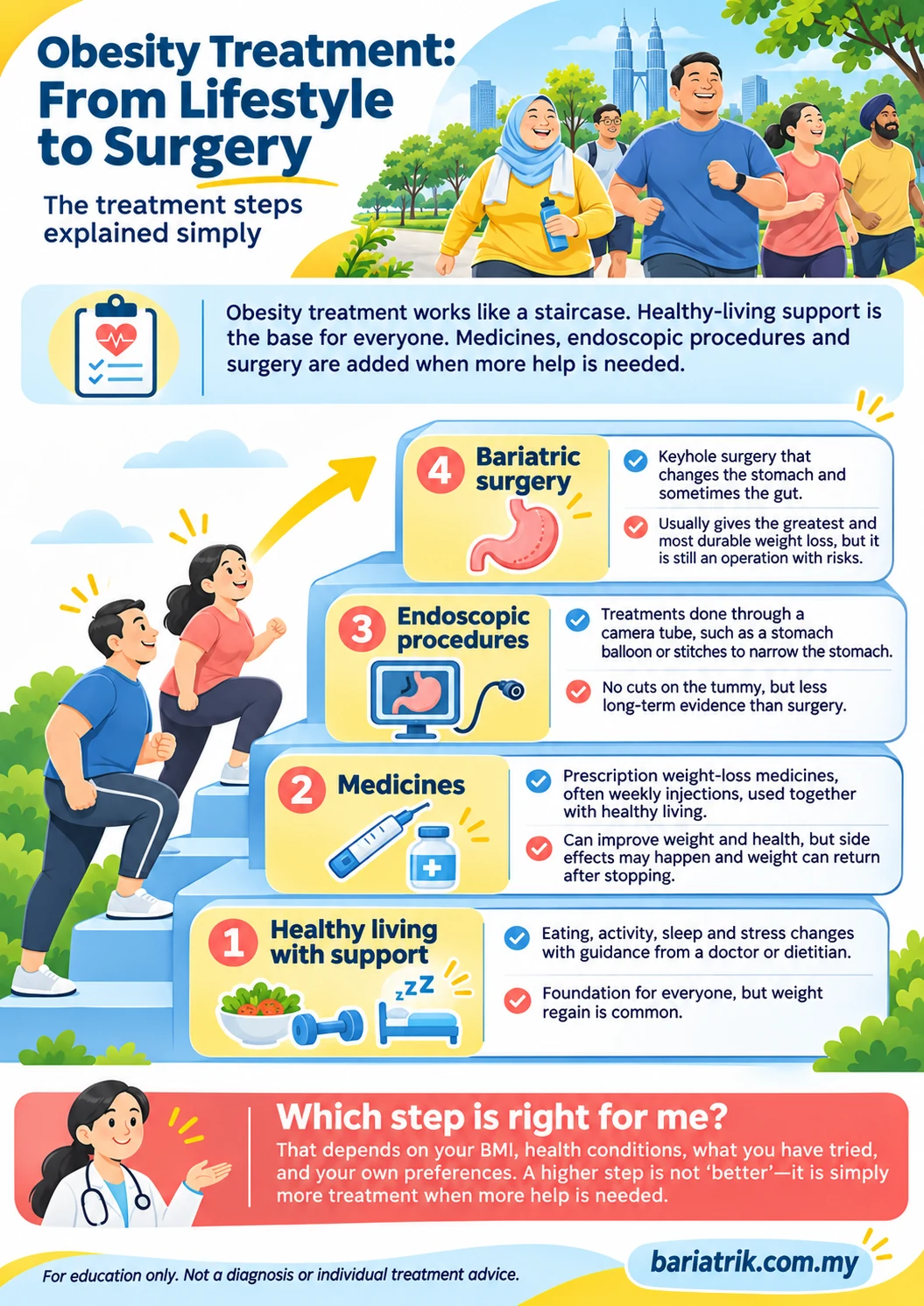
One-page infographic
Obesity treatment: from lifestyle to surgery
The staircase with one line on each step, on one printable sheet.
View and printRead next
References
- [8]Lean MEJ, et al. Primary care-led weight management for remission of type 2 diabetes (DiRECT). Lancet 2018;391(10120):541–551. doi:10.1016/S0140-6736(17)33102-1
- [9]Lean MEJ, et al. Durability of a primary care-led weight-management intervention for remission of type 2 diabetes: 2-year results of DiRECT. Lancet Diabetes Endocrinol 2019;7(5):344–355. doi:10.1016/S2213-8587(19)30068-3
- [10]Look AHEAD Research Group. Cardiovascular effects of intensive lifestyle intervention in type 2 diabetes. N Engl J Med 2013;369(2):145–154. doi:10.1056/NEJMoa1212914
- [11]Wilding JPH, et al. Once-weekly semaglutide in adults with overweight or obesity (STEP 1). N Engl J Med 2021;384(11):989–1002. doi:10.1056/NEJMoa2032183
- [12]Wilding JPH, et al. Weight regain and cardiometabolic effects after withdrawal of semaglutide: the STEP 1 trial extension. Diabetes Obes Metab 2022;24(8):1553–1564. doi:10.1111/dom.14725
- [13]Abu Dayyeh BK, et al. Endoscopic sleeve gastroplasty for treatment of class 1 and 2 obesity (MERIT). Lancet 2022;400(10350):441–451. doi:10.1016/S0140-6736(22)01280-6
- [14]Courcoulas AP, et al. Long-term outcomes of medical management vs bariatric surgery in type 2 diabetes. JAMA 2024;331(8):654–664. doi:10.1001/jama.2024.0318
- [15]Schiavon CA, et al. Randomized trial of effect of bariatric surgery on blood pressure after 5 years (GATEWAY). J Am Coll Cardiol 2024;83(6):637–648. doi:10.1016/j.jacc.2023.11.032
- [21]Brown A, et al. Real-world effectiveness of semaglutide and tirzepatide compared with bariatric surgery. Obesity (Silver Spring) 2026;34(8):1583–1591. doi:10.1002/oby.70246