Obesity is a disease. It can be treated.
Obesity and bariatric surgery, explained simply
A simple guide to what obesity is, how it affects health, and the treatments that exist in Malaysia, including bariatric surgery (pembedahan bariatrik).
Written by Dato' Dr Tikfu Gee, MBBS, MS (Surgery), Fellowship in MIS (France)

Obesity is a long-term disease in which the body stores too much fat, and it raises the risk of diabetes, heart disease and other illnesses. Treatment ranges from healthy-living support and medicines to endoscopic procedures and bariatric surgery, and a qualified doctor can help decide what fits.
Key points
- More than half of Malaysian adults are overweight or living with obesity [5].
- Obesity is not a personal failing. Hormones, genes and surroundings all play a part.
- For people of Asian descent, health risk rises at a lower BMI.
- There are several treatments. No single one suits everyone.
- Bariatric surgery is a medical treatment for health. It is not cosmetic surgery.
Start here
Obesity in Malaysia: quick facts
Common questions
What is bariatric surgery (pembedahan bariatrik)?
A group of keyhole operations on the stomach and gut that treat obesity and related illnesses such as type 2 diabetes. People sometimes call it “pembedahan kurus” or “potong perut”; the medical name is pembedahan bariatrik.
Is obesity a disease?
Yes. An international expert commission backed by 76 health organisations describes clinical obesity as a long-term illness in which excess body fat harms how organs work [1].
What BMI is obese for Asians?
For Asian populations, health risk is increased from a BMI of 23 and high from 27.5 [6]. Waist size of 90 cm or more for men and 80 cm or more for women also signals higher risk [5].
What is the first step if I am worried about my weight?
See a family doctor or a government health clinic (Klinik Kesihatan). Ask for a health check and a talk about your options.
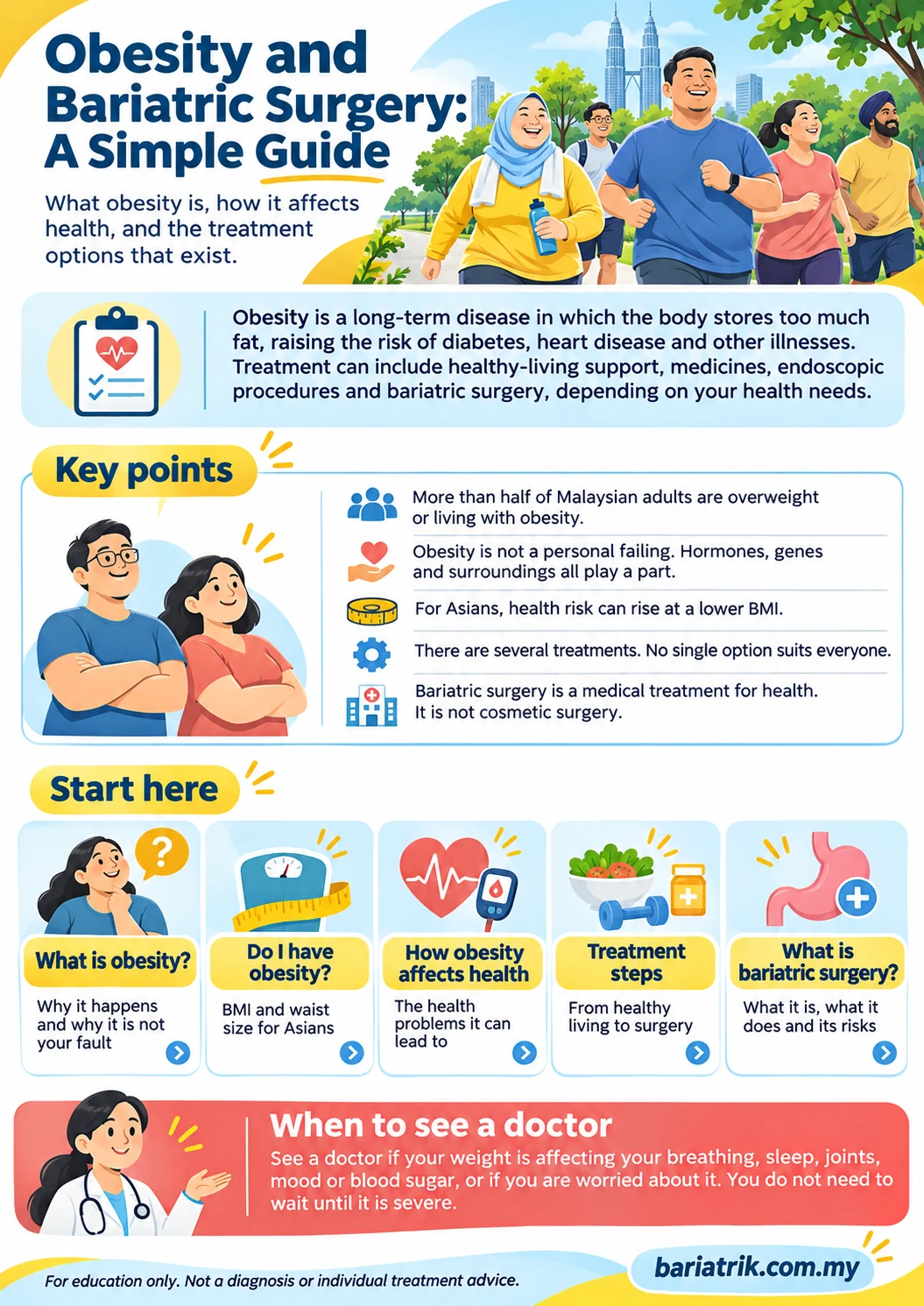
One-page infographic
Obesity and bariatric surgery: a simple guide
The whole home page on one sheet, to read offline or share with family.
View and printReferences
- [1]Rubino F, et al. Definition and diagnostic criteria of clinical obesity. Lancet Diabetes Endocrinol 2025;13(3):221–262. doi:10.1016/S2213-8587(24)00316-4
- [5]Institute for Public Health, National Institutes of Health, Ministry of Health Malaysia. National Health and Morbidity Survey (NHMS) 2023: Non-Communicable Diseases and Healthcare Demand. Key Findings. 2024. https://iku.moh.gov.my/nhms-2023
- [6]WHO Expert Consultation. Appropriate body-mass index for Asian populations and its implications for policy and intervention strategies. Lancet 2004;363(9403):157–163. doi:10.1016/S0140-6736(03)15268-3