Understand obesity
Do I have obesity? BMI and waist size for Asians
How to work out your body mass index (BMI), the lower Asian ranges, and why your waist matters too.
Written by Dato' Dr Tikfu Gee, MBBS, MS (Surgery), Fellowship in MIS (France)
Doctors use body mass index (BMI) and waist size as first checks. For people of Asian descent, health risk rises at a lower BMI than the international cut-offs, so lower “action points” are used: 23 and 27.5.
BMI and waist explainer (Asian ranges)
Shows the ranges only. It gives no diagnosis and does not save anything you type.
Your BMI
Type your weight and height to see where your BMI sits.
Waist:
These numbers do not diagnose anything. A doctor looks at your whole health.
Step 1: How do I calculate my BMI?
BMI = your weight in kilograms, divided by your height in metres, divided by your height in metres again.
Example: 80 kg and 1.60 m tall. 80 ÷ 1.60 ÷ 1.60 = 31.
Step 2: How do I read a BMI result as an Asian adult?
| BMI | For Asian adults [6] |
|---|---|
| Below 18.5 | Underweight |
| 18.5 to 22.9 | Lower risk |
| 23.0 to 27.4 | Increased risk |
| 27.5 and above | High risk |
These categories are for screening only. They are not a diagnosis.
Step 3: How do I measure my waist?
Fat around the tummy is more harmful than fat elsewhere. Measure around your waist at the level of your belly button, breathing out gently.
| Waist size that signals higher risk [5] | |
|---|---|
| Men | 90 cm or more |
| Women | 80 cm or more |
Good to know
- BMI is a rough guide. It cannot tell fat from muscle, and it does not show where fat is stored.
- These numbers do not diagnose anything. A doctor looks at your whole health: blood pressure, blood sugar, cholesterol, sleep, joints and how you feel.
- The explainer on this page shows the ranges only. It does not save anything you type.
Want more detail? Tap to open
- The World Health Organization expert group found that Asian populations face higher risk of type 2 diabetes and heart disease at lower BMI, and added action points at 23 and 27.5 [6].
- Malaysia’s 2023 national health survey reported that 54.4% of adults had a BMI of 25 or above, up from 44.5% in 2011 [5].
Common questions
Why is BMI different for Asians?
At the same BMI, people of Asian descent tend to have more body fat and a higher risk of diabetes and heart disease.
What BMI is obese in Malaysia?
Using the Asian action points, a BMI of 27.5 or above is high risk and 23 to 27.4 is increased risk [6]. A doctor confirms obesity by looking at your whole health, not BMI alone.
Do I need treatment if I feel well?
Excess body fat can harm health silently. A check-up can show whether your blood pressure, blood sugar or liver are affected.
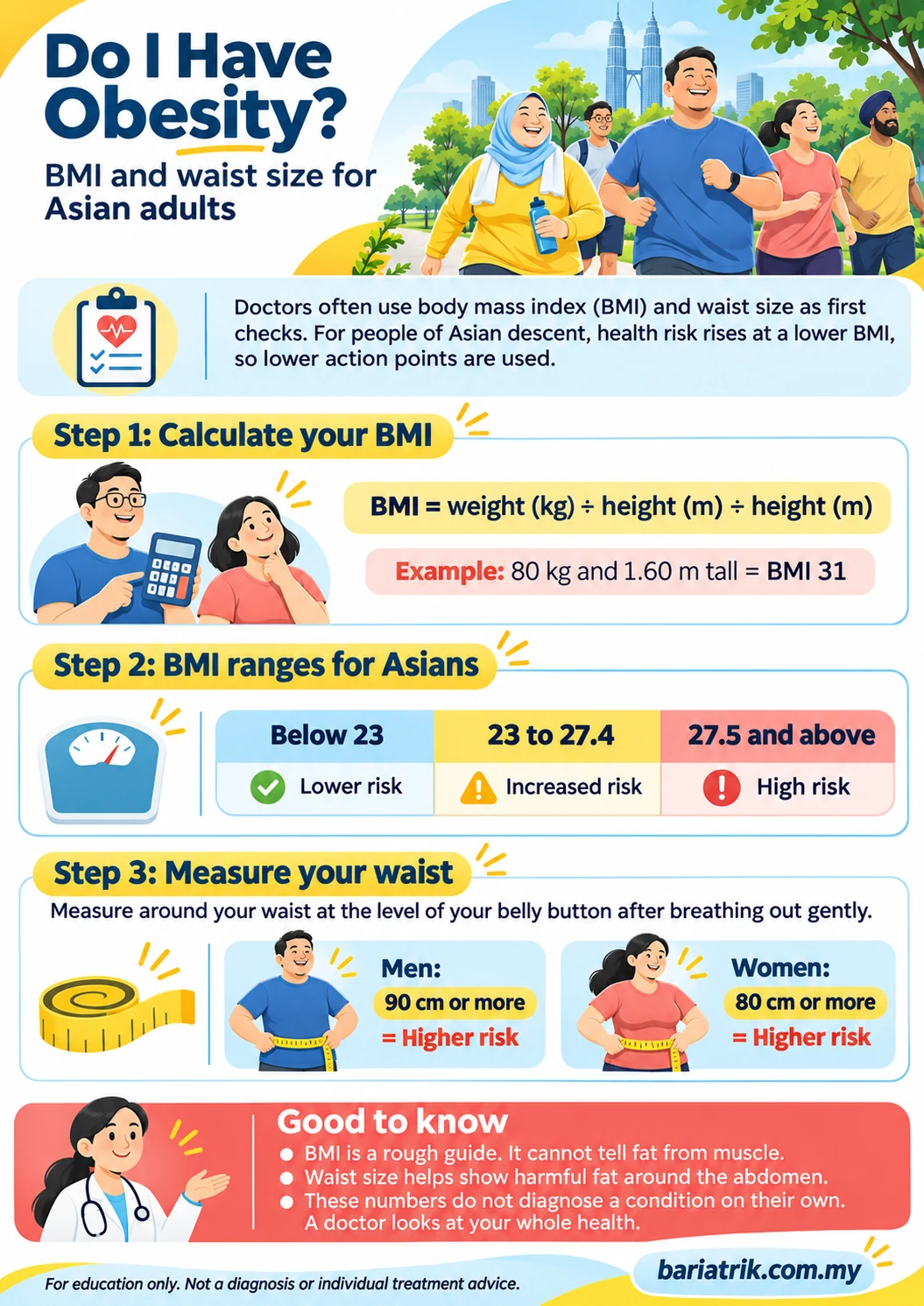
One-page infographic
BMI and waist for Asian adults
How to measure, the Asian ranges and space to write your own numbers to show a doctor.
View and printRead next
References
- [5]Institute for Public Health, National Institutes of Health, Ministry of Health Malaysia. National Health and Morbidity Survey (NHMS) 2023: Non-Communicable Diseases and Healthcare Demand. Key Findings. 2024. https://iku.moh.gov.my/nhms-2023
- [6]WHO Expert Consultation. Appropriate body-mass index for Asian populations and its implications for policy and intervention strategies. Lancet 2004;363(9403):157–163. doi:10.1016/S0140-6736(03)15268-3