Understand obesity
What is obesity? Why it is a disease
Why the body stores too much fat, why weight comes back after dieting, and why it is not about willpower.
Written by Dato' Dr Tikfu Gee, MBBS, MS (Surgery), Fellowship in MIS (France)

Obesity is a long-term disease in which too much body fat builds up and starts to harm health. It is caused by a mix of biology and surroundings, not by laziness or lack of willpower.
Key points
- Your brain has a “weight thermostat”. It decides how hungry you feel and how much energy you burn.
- In obesity, the thermostat is set too high, and the body works to keep the weight on.
- Genes, hormones, sleep, stress, some medicines and the food around us all push the setting up.
- This is why dieting alone is so hard to keep up. It is biology, not weakness.
What causes obesity?
Obesity is caused by many things working together. The main ones are:
- Genes passed down in families
- Hormones that control hunger and fullness
- Too little sleep and ongoing stress
- Some medicines
- The food and surroundings around us every day
These push the brain’s “weight thermostat” up, so the body defends a higher weight.
Why does weight come back after dieting?
When you lose weight by eating less, your body thinks food is running short. It fights back in two ways:
1. You feel hungrier
Hunger hormones rise and fullness hormones fall. In one study, these changes were still there a year after the diet [3].
2. You burn less energy
The body slows down to save fuel. In a small study of people who had lost a lot of weight quickly, this slow-down was still present six years later, and most of the weight had returned [4].
Is obesity really a disease?
Yes. An international group of experts, backed by 76 health organisations, describes clinical obesity as a long-term illness in which excess body fat harms how organs work. They say care should be based on evidence, not on blaming the individual [1].
What obesity is not
- It is not a character flaw.
- It is not always visible. Some people carry harmful fat around their organs without looking large.
- It is not solved by being told to “eat less and move more”. Those matter, but for many people they are not enough by themselves.
Want more detail? Tap to open
- Hormone study: adults lost weight on a very-low-energy diet. One year later, levels of leptin, ghrelin, peptide YY and other appetite hormones, and hunger itself, were still different from before the diet [3].
- Energy study: 14 people were followed six years after a rapid weight-loss competition. Resting energy use was still about 500 kilocalories a day lower than expected for their body size [4]. This was a small study of an extreme situation.
- The expert commission distinguishes “clinical obesity” (fat is already harming health) from “preclinical obesity” (excess fat, with health still preserved but risk raised) [1].
Common questions
Is obesity my fault?
No. It is a disease with many causes, most of them outside a person’s control.
What is the difference between overweight and obesity?
Both mean more body fat than is healthy. Obesity is the stage where the extra fat is more likely to harm health. Doctors use BMI and waist size as first checks, with lower cut-offs for Asians.
What is the “weight thermostat”?
A plain-words name for the brain’s control of hunger and energy use. In obesity it is set higher, so the body works to hold on to the extra weight.
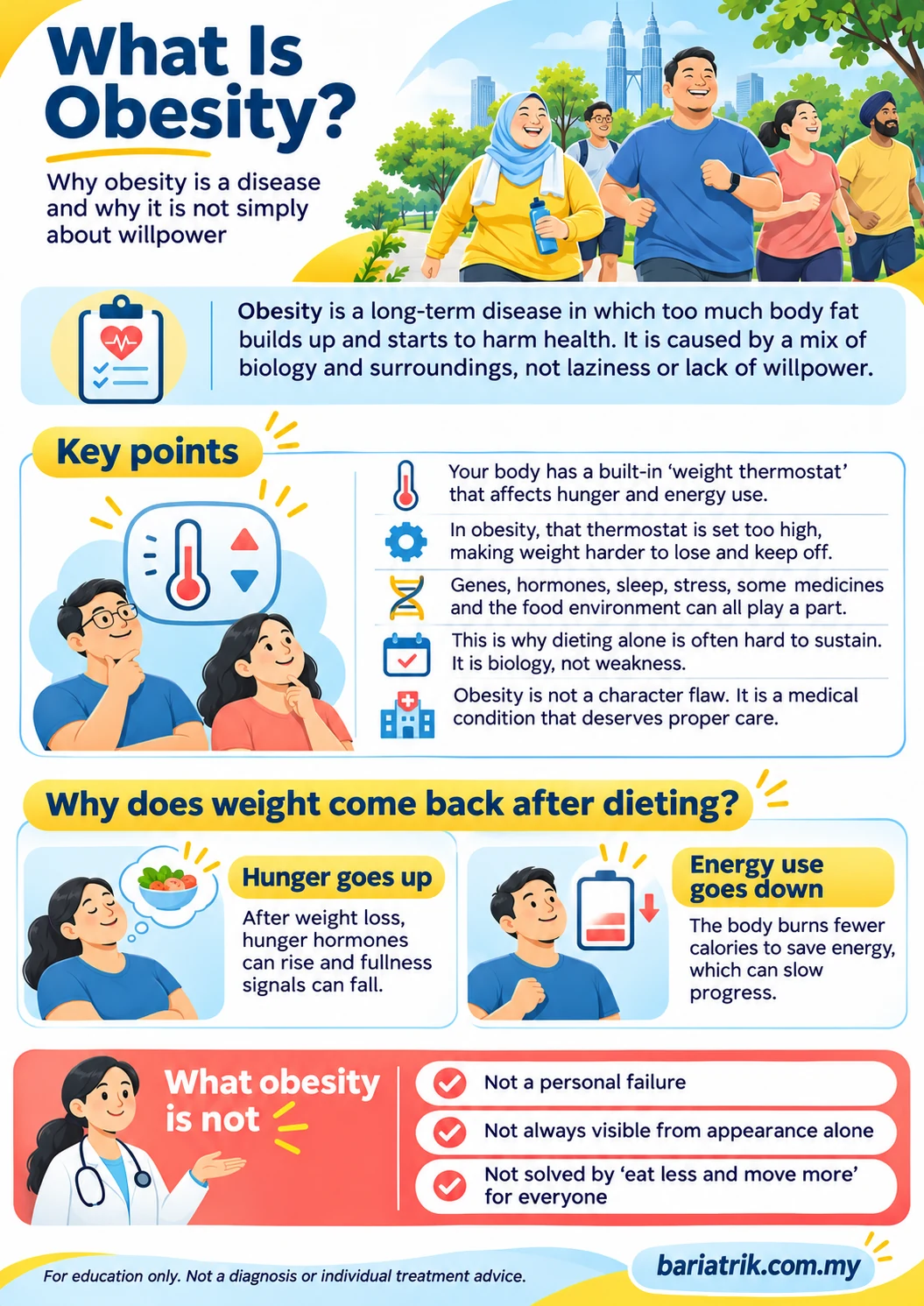
One-page infographic
What is obesity?
The weight thermostat and why weight comes back, on one printable sheet.
View and printRead next
References
- [1]Rubino F, et al. Definition and diagnostic criteria of clinical obesity. Lancet Diabetes Endocrinol 2025;13(3):221–262. doi:10.1016/S2213-8587(24)00316-4
- [3]Sumithran P, et al. Long-term persistence of hormonal adaptations to weight loss. N Engl J Med 2011;365(17):1597–1604. doi:10.1056/NEJMoa1105816
- [4]Fothergill E, et al. Persistent metabolic adaptation 6 years after “The Biggest Loser” competition. Obesity (Silver Spring) 2016;24(8):1612–1619. doi:10.1002/oby.21538