Learn more
Obesity and bariatric surgery: frequently asked questions
Short, plain answers to the questions people ask most, and a glossary of the words doctors use.
Written by Dato' Dr Tikfu Gee, MBBS, MS (Surgery), Fellowship in MIS (France)
Obesity is a long-term disease, not a personal failing. BMI and waist size are first checks, with lower cut-offs for Asians. Treatment goes in steps from healthy living to medicines, endoscopic procedures and bariatric surgery, and a doctor can help decide what fits.
About obesity
Is obesity my fault?
No. It is a disease with many causes, most of them outside a person’s control.
How do I know if I have obesity?
BMI and waist size are first checks. A doctor can assess your overall health. See Do I have obesity?
Why is BMI different for Asians?
At the same BMI, people of Asian descent tend to have more body fat and a higher risk of diabetes and heart disease [6].
Do I need treatment if I feel well?
Excess body fat can harm health silently. A check-up can show whether your blood pressure, blood sugar or liver are affected.
About treatment
What is the first step?
See a family doctor or a government health clinic. Ask for a health check and a talk about your options.
Are weight-loss injections safe?
They are prescription medicines with known side effects, mostly on the stomach and gut. They should be used only under a doctor’s care.
About bariatric surgery
What is bariatric surgery?
A group of keyhole operations on the stomach and gut that treat obesity and related illnesses. See What is bariatric surgery?
Is bariatric surgery only for very large people?
No. Guidelines use BMI together with health conditions, with lower thresholds for Asian populations [7].
Will surgery cure my diabetes?
It can improve diabetes, and some people go into remission. It is not a guaranteed or permanent cure.
Is surgery safe?
Serious problems are uncommon but do happen. Life-long vitamins and check-ups are needed.
Where can I read more?
See “Related educational resources” at the foot of each page: bariatrikterbaik.com for the research and mybariatrik.com for before and after surgery.
Glossary: words in plain language
- Bariatric surgery (pembedahan bariatrik)
- Operations on the stomach and gut to treat obesity
- BMI (indeks jisim badan)
- Weight in kilograms divided by height in metres squared
- Endoscopic procedure
- A treatment done through a camera tube passed down the throat
- Fatty liver
- A build-up of fat in the liver
- Hormone
- A chemical messenger in the body
- Metabolic surgery
- Another name for bariatric surgery, for its effect on diabetes
- Obesity (obesiti)
- A long-term disease of excess body fat that harms health
- Remission
- For type 2 diabetes, remission means blood sugar no longer meets the criteria for diabetes without glucose-lowering medicines for a period of time. Diabetes can still come back.
- Sleep apnoea
- Pauses in breathing during sleep
- Stigma
- Unfair blame or shame directed at a person
- Waist circumference (ukur lilit pinggang)
- The distance around the waist
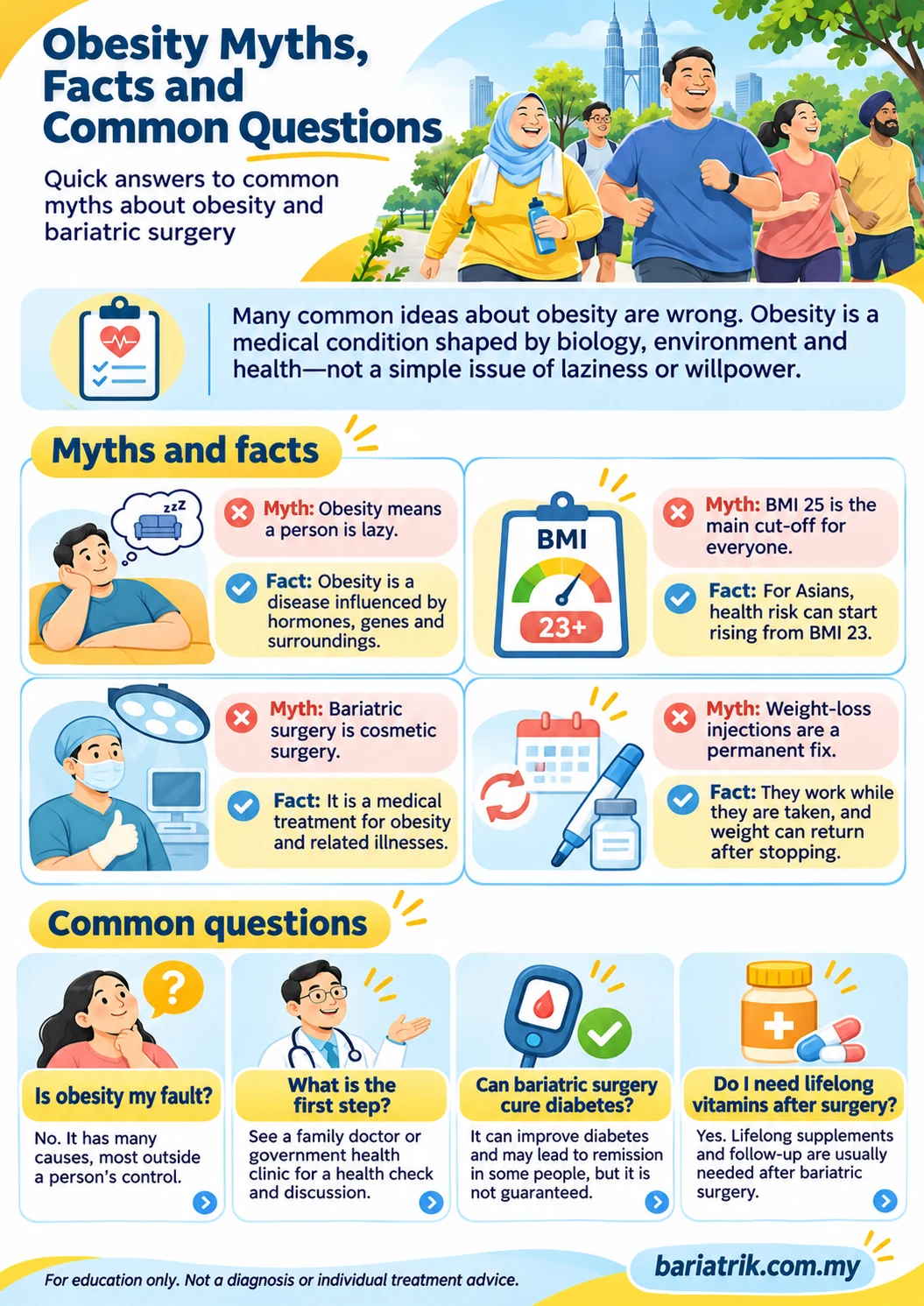
One-page infographic
Obesity myths, facts and FAQ
Myths, facts and the common questions on one printable sheet.
View and printReferences
- [6]WHO Expert Consultation. Appropriate body-mass index for Asian populations and its implications for policy and intervention strategies. Lancet 2004;363(9403):157–163. doi:10.1016/S0140-6736(03)15268-3
- [7]Eisenberg D, et al. 2022 ASMBS and IFSO indications for metabolic and bariatric surgery. Obes Surg 2023;33(1):3–14. doi:10.1007/s11695-022-06332-1