Treatment
What is bariatric surgery (pembedahan bariatrik)?
What the operations are, what they can and cannot do for health, the risks, and who they are for, in plain words.
Written by Dato' Dr Tikfu Gee, MBBS, MS (Surgery), Fellowship in MIS (France)

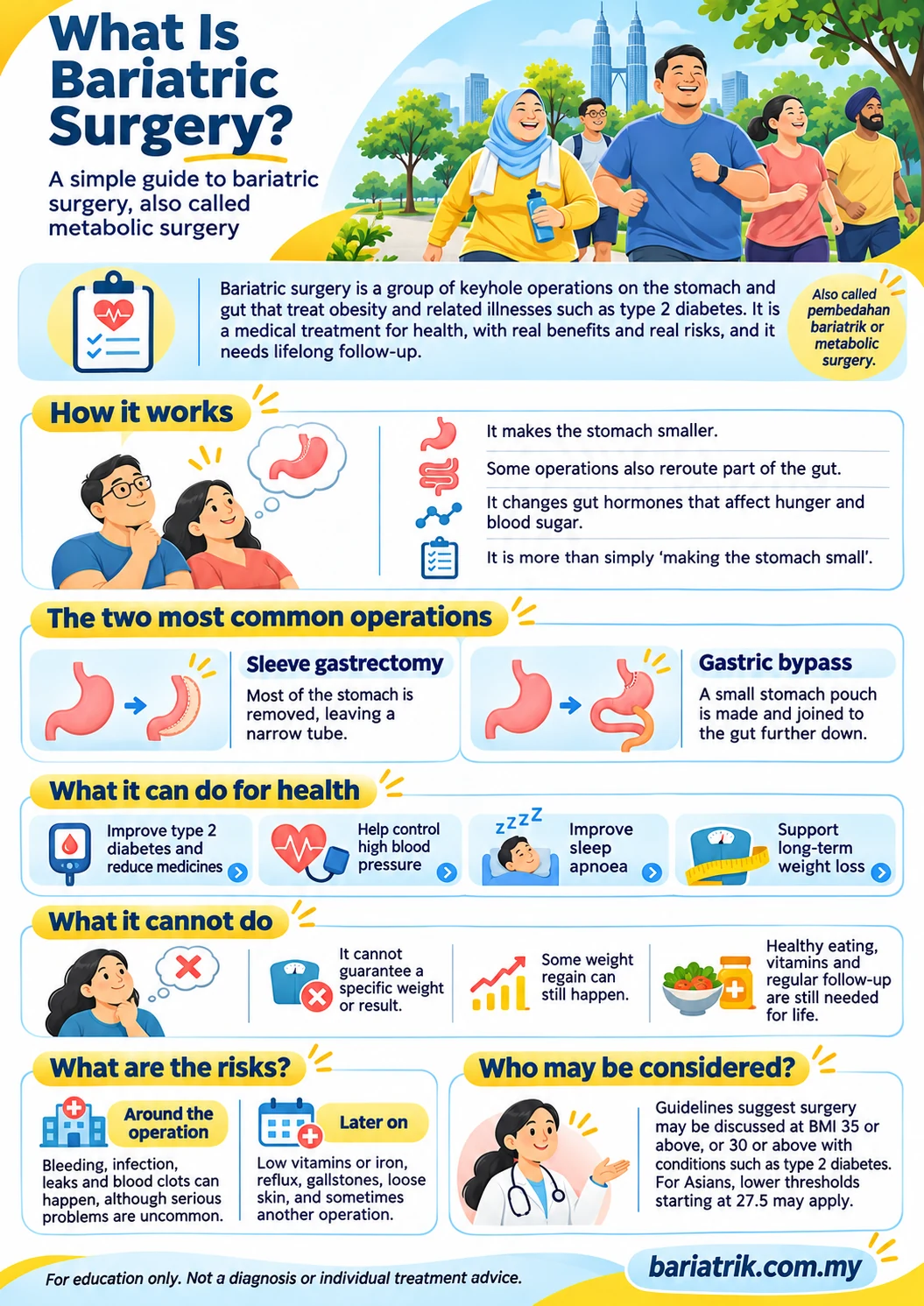
Bariatric surgery, also called metabolic surgery, is a group of keyhole operations on the stomach and gut that treat obesity and related illnesses such as type 2 diabetes. It is a medical treatment for health, with real benefits and real risks, and it needs life-long follow-up.
Key points
- “Bariatrik” comes from a Greek word for weight. “Metabolic” refers to its effect on blood sugar and other body chemistry.
- People sometimes call it “pembedahan kurus” or “potong perut”. The medical name is pembedahan bariatrik.
- It works by changing the stomach’s size and the gut hormones that control hunger and blood sugar. It is more than “making the stomach small”.
- It is not cosmetic surgery, and it does not remove fat from under the skin.
- It is one tool. Healthy eating, activity, supplements and check-ups continue for life.
What are the most common operations?
Sleeve gastrectomy
Most of the stomach is removed, leaving a narrow tube about the shape of a banana.
Gastric bypass
A small stomach pouch is made and joined to the gut further down, so food skips part of the stomach and gut.
Other operations exist. The evidence site bariatrikterbaik.com compares them.
What can bariatric surgery do for health?
| What studies found, in plain words | |
|---|---|
| Type 2 diabetes | Better control and fewer medicines. Some people go into remission, though not everyone, and it may not last [14] |
| High blood pressure | Fewer tablets for many people. Almost half no longer had high blood pressure after five years in one trial [15] |
| Sleep apnoea | Went away in most people in one trial analysis [22] |
| Fatty liver | Liver inflammation cleared in more than half within a year in one trial [16] |
| Length of life | People who had surgery lived about three years longer on average in a long Swedish study [17] |
What can it not do?
- It cannot guarantee a particular weight or a particular result.
- Changes to eating and regular follow-up are important to keep the results over the long term.
- It does not stop weight from ever returning. Some regain is common.
- It is not a way to look younger. Research on ageing after surgery is at an early stage, and appearance changes differ from person to person.
Is bariatric surgery safe? What are the risks?
- Around the operation: bleeding, infection, a leak from a staple line or join, and blood clots. Serious problems are uncommon. Based on studies, the risk of death around the time of surgery is estimated at about 1 in 1,000, but the actual risk varies with each patient’s health and the type of operation [19].
- Later on: low vitamins and iron, acid reflux, gallstones, loose skin, and sometimes another operation. In one trial, about 16 to 19 in 100 people had a further operation within ten years [18].
- For life: daily supplements and regular blood tests [20].
Who is bariatric surgery for?
International guidelines suggest surgery can be considered at a BMI of 35 or above, or 30 or above with a condition such as type 2 diabetes. For people of Asian descent, bariatric surgery may be considered at a BMI as low as 27.5, depending on their health and an assessment by the medical team [7]. Reaching a threshold means surgery can be discussed. A team assessment decides whether it is suitable.
BMI 35+
Can be considered
BMI 30+
With a condition such as type 2 diabetes
As low as 27.5
For people of Asian descent, depending on health and the team’s assessment
For what happens before and after surgery, see mybariatrik.com.
Want more detail? Tap to open
- Diabetes: in four trials combined, remission at seven years was 18.2% after surgery and 6.2% with medical care [14].
- Blood pressure: remission in 46.9% after gastric bypass and 2.4% with medicines at five years [15].
- Sleep apnoea: no sleep apnoea in 70.8% three years after bypass, from 4.2% before [22].
- Fatty liver inflammation: cleared in 56% to 57% after surgery and 16% with lifestyle care at one year [16].
- Cancer: obesity-related cancers were about one-third less common over ten years in a follow-up study [23].
- Life expectancy: 3.0 years longer than similar people without surgery, but still shorter than the general population [17].
- A Malaysian hospital series of 1,478 patients reported an overall complication rate of 1.7% [24].
- Follow-up studies compare people who chose surgery with those who did not, so they cannot prove surgery was the cause of the difference.
Common questions
Is bariatric surgery only for very large people?
No. Guidelines use BMI together with health conditions, with lower thresholds for Asian populations.
Will surgery cure my diabetes?
It can improve diabetes, and some people go into remission. It is not a guaranteed or permanent cure.
Is surgery safe?
Serious problems are uncommon but do happen. Based on studies, the risk of death around surgery is about 1 in 1,000, and it varies with each patient’s health and the type of operation [19]. Life-long vitamins and check-ups are needed.
Sleeve or bypass: which is better?
Neither is better for everyone. The choice depends on your health conditions, reflux, and what you and the team decide together. bariatrikterbaik.com compares them in detail.
Is bariatric surgery the same as liposuction?
No. Liposuction removes fat from under the skin for appearance. Bariatric surgery works on the stomach and gut hormones to treat a disease.
One-page infographic
What is bariatric surgery?
How it works, the two common operations, benefits, limits and risks, on one printable sheet.
View and printRead next
References
- [7]Eisenberg D, et al. 2022 ASMBS and IFSO indications for metabolic and bariatric surgery. Obes Surg 2023;33(1):3–14. doi:10.1007/s11695-022-06332-1
- [14]Courcoulas AP, et al. Long-term outcomes of medical management vs bariatric surgery in type 2 diabetes. JAMA 2024;331(8):654–664. doi:10.1001/jama.2024.0318
- [15]Schiavon CA, et al. Randomized trial of effect of bariatric surgery on blood pressure after 5 years (GATEWAY). J Am Coll Cardiol 2024;83(6):637–648. doi:10.1016/j.jacc.2023.11.032
- [16]Verrastro O, et al. Bariatric-metabolic surgery versus lifestyle intervention plus best medical care in non-alcoholic steatohepatitis (BRAVES). Lancet 2023;401(10390):1786–1797. doi:10.1016/S0140-6736(23)00634-7
- [17]Carlsson LMS, et al. Life expectancy after bariatric surgery in the Swedish Obese Subjects study. N Engl J Med 2020;383(16):1535–1543. doi:10.1056/NEJMoa2002449
- [18]Salminen P, et al. Laparoscopic sleeve gastrectomy vs Roux-en-Y gastric bypass at 10 years (SLEEVEPASS). JAMA Surg 2022;157(8):656–666. doi:10.1001/jamasurg.2022.2229
- [19]Robertson AGN, et al. Perioperative mortality in bariatric surgery: meta-analysis. Br J Surg 2021;108(8):892–897. doi:10.1093/bjs/znab245
- [20]O’Kane M, et al. BOMSS guidelines on perioperative and postoperative biochemical monitoring and micronutrient replacement after bariatric surgery: 2020 update. Obes Rev 2020;21(11):e13087. doi:10.1111/obr.13087
- [22]Furlan SF, et al. Three-year effects of bariatric surgery on obstructive sleep apnea in obesity grade 1 and 2: GATEWAY sub-analysis. Int J Obes (Lond) 2021;45(4):914–917. doi:10.1038/s41366-021-00752-2
- [23]Aminian A, et al. Association of bariatric surgery with cancer risk and mortality in adults with obesity. JAMA 2022;327(24):2423–2433. doi:10.1001/jama.2022.9009
- [24]Tan WL, et al. Long-term weight loss and metabolic outcomes after bariatric surgery in a large Asian cohort. Obes Surg 2026;36(7):3736–3744. doi:10.1007/s11695-026-08770-7